A non-traditional human navigating being a non-traditional PhD student
How Did You Get Here?*
Get link
Facebook
X
Pinterest
Email
Other Apps
So, like I mentioned in my first post, I am back in school after 10 years. I already had an MPH. I had a pretty lucrative career. It was very intense (sometimes working until 10pm, 12 am or a few times as late as 4 am) but I often got to travel, and when I had free time I traveled even more. I can't remember how many countries I'd been to before I left the US for Seoul in December 2008, but last summer I made it to 50 (and I'd like to double that by the time I am 50).
Photo credit: Google
I say all of this to say, people kind of saw this coming but didn't really see this coming. A long time ago, I was a pre-med student. I have always been interested in human psyche and behavior, so I majored in something called Neuroscience and Behavioral Biology. I like to call this a fancy triple major of Anthropology, Biology, and Psychology . The Anthropology 101 class I took my freshman year was to blame for this, and still remains my favorite class of all time, the professor was amazing.
AmeriCorps Logo
I was still planning to go to medical school when I took a year off to volunteer (AmeriCorps). I worked at a community health center in upstate New York and I found myself drawn to the idea of preventing people from getting sick, rather than treating them after they were already sick, and so I was drawn to the field of public health. I decided get the masters, and to concentrate in Epidemiology, but I also took a lot of international health electives because I found this field interesting too. Plus, I eventually wanted to work globally.
Photo credit: Google
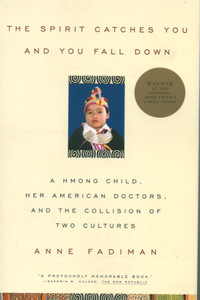
It was here that I took two classes that would have a profound impact on my future career trajectory and convince me that I did not want to go to medical school (and to be honest maybe I just didn't want to take a second semester of organic chemistry ). Those classes were called, the HIV Pandemic , and Medical Anthropology respectively. In the latter class I read a book that would touch my life forever - "The Spirit Catches You and You Fall Down." The story is of a Hmong refugee family in the US who's daughter is diagnosed with a severe form of epilepsy. In their culture it is a revered condition, you are a considered a shaman and able to converse with the gods. In the US, it's an illness. Without giving away too much of the book - the outcome leaves you wondering, what if those in the medical field had understood the cultural perspective, or vice versa? Would things have ended differently? I was hooked. I told myself I would look more into that field one day, but in the meantime I moved to South Korea.
Years later I moved to Nigeria to work in public health, and I working on an HIV/AIDS program. I remember asking why we were using western interventions in an obviously different cultural setting. I was laughed at and I stopped asking those questions. As I continued to work in the field I felt a sense of frustration that something was missing. The more I thought about it the more I saw that culture was the missing link. Every intervention needs to be adapted to each unique cultural setting. Ironically by the time I was leaving many people recognize the need for this in the field.
Photo credit: dutchreview.com
I actually didn't plan to stay abroad as long as I did, but I guess everything happens for a reason. I finally got my butt in action to pursue my dream, applied, and the rest they say is history, cos here I am, a first year PhD student in Medical Anthropology and Global Health. I guess in a way, I'll still get to be a doctor right? What is medical anthropology you might ask? My simple definition is that it is the study of human culture and disease. There are other examples from my childhood. Growing up between multiple worlds as a third culture kid I remember being interested in how Westerns dealt with depression compared to many other cultures. In a way it makes perfect sense. In order to understand and successfully defeat any disease you need to understand biology, epidemiology, and culture (anthropology) to do so. I have the first two pieces and one day (5+ years from now) I'll have the third. I think it is a unique position as most people usually need to build interdisciplinary teams for their research. I will be the interdisciplinary team.
I'm only one month in and my next post will have more on what that has been like... but for now I really need to go write a paper
*Nobody's Supposed to be Here by Deborah Cox was an epic song in my youth. I always remember her belting this line out. And no, I cannot promise that all the titles of my blog posts won't be related to a song I like. It's kind of my thing 😆
I'm starting this blog as a way to keep up with my newest journey, working on my PhD. Here are the key things you need to know to understand my perspective: I'm a " non-traditional " grad student*: I got my master's degree many years ago (10 actually) before deciding to go back to school again for my doctorate I am a former third-culture kid addicted to travel - I've been to 50 countries and counting. You can read about some of my pre PhD life living in South Korea and Nigeria . I'm passionate about many things (inequity and health disparities primarily) and I'm a nut job (well clearly, since I left a lucrative career to go back to school) I can't promise I'll write as frequently as I should but it should be fun documenting all the crazy fun times And if you caught the the title of this blog is a play on blink-182's song ...well, I'm not too sure you should be proud of that. (Note: no actual nudity but ...
Los Haitises National Park , The Dominican Republic on My Birthday Yay!!! I've successfully completed my first year as a PhD student. That involved getting something called a high pass (similar to like pass with distinction I guess) on a grueling 6 hour comprehensive exam. It had to be a high pass. Just a regular pass is good enough to get a masters, but not to begin the PhD program. Oh yeah, that whole first year wasn't even the PhD program, it was prerequisite classes for the program. So year 2 is the real year one. Now you know why US PhD programs take that much time. (If you're interested click here to see the requirements so you know what I'm going through). But hold up, let us back up a little bit since obviously, it has been a crazy amount of time since I last wrote. What did I even say? I can't remember. I think I was telling you why I was going to do this program. Nearly a whole year has passed since then. It's been a really tough journey full...





Comments
Post a Comment